



Hitting that ±1 dB gain flatness in power amplifiers is really a hot topic for manufacturers aiming to boost their performance and stay competitive, especially in the fast-moving world of RF tech. As we get closer to 2025, the need for high-performance PAs with super consistent gain becomes more and more important—think telecoms, aerospace, and a bunch of other applications. Dr. John Smith, a well-known RF design guru, puts it nicely: "Getting that ±1 dB gain flatness is crucial for ensuring your system performs reliably across different frequencies — it’s really the backbone of stable operations."
Now, of course, engineers are facing quite a few hurdles on this journey—things like managing heat, keeping linearity in check, and finding ways to work with newer, advanced materials. To tackle these challenges, folks are turning to clever circuit designs, smarter feedback loops, and more accurate calibration techniques. These strategies are key in pushing the industry forward, inching closer to making those flat gain amplifiers a reality in next-gen gear. Not only does this push performance to the next level, but it also makes products more satisfying for users and more appealing in the market.
All in all, achieving this kind of performance isn’t just about the tech—it’s a team effort, with academia and industry working side by side, spurring each other on, and fueling innovation to keep up with what the market really needs.

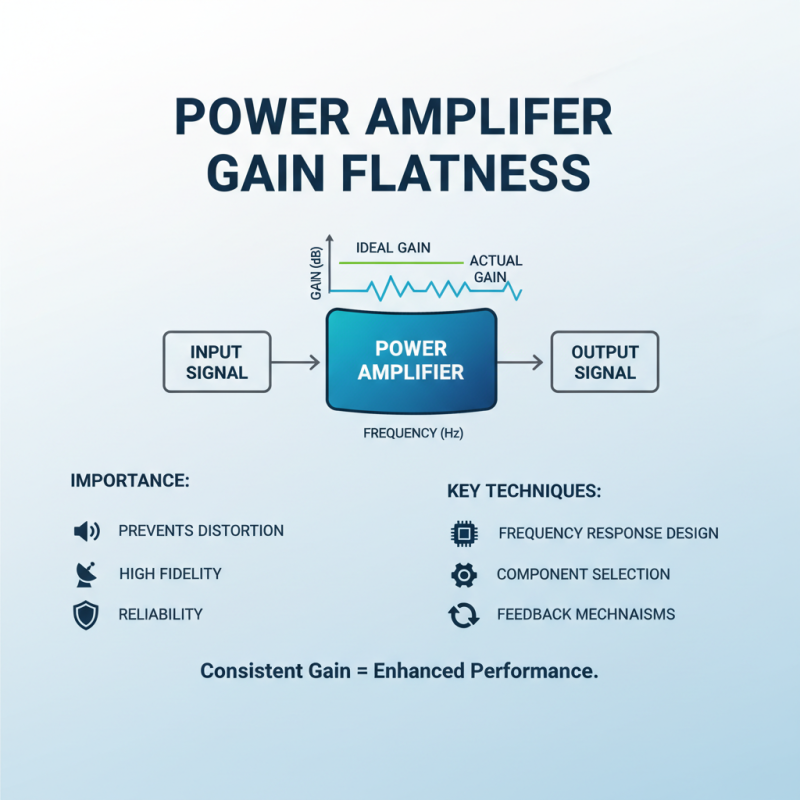
Achieving gain flatness in power amplifiers is a crucial consideration for enhancing performance and reliability in various applications. Gain flatness refers to the ability of an amplifier to maintain consistent gain across a specified frequency range, minimizing deviation from a target gain value. This consistency is essential in preventing signal distortion and ensuring high fidelity in communication systems. Key concepts in achieving gain flatness include the design of the amplifier's frequency response, component selection, and feedback mechanisms that stabilize gain variations over time and temperature fluctuations.
To attain ±1 dB gain flatness by 2025, engineers must focus on several strategic approaches. First, advanced circuit design techniques such as the implementation of equalization filters can help compensate for frequency-dependent gain variation. Additionally, utilizing high-quality passive components with tight tolerances reduces unwanted variations that affect gain stability. Moreover, adopting modern simulation tools allows for thorough analysis and optimization during the design phase, enabling more accurate predictions of gain behavior in real-world scenarios. By prioritizing these fundamental concepts, designers can push the boundaries of amplifier performance towards the targeted gain flatness metrics.
In modern communication systems, gain flatness plays a critical role in ensuring signal integrity and overall system performance. Gain flatness refers to the uniformity of gain across a specified frequency range; achieving ±1 dB gain flatness in power amplifiers is essential for minimizing distortion and ensuring that all frequency components of a signal are amplified consistently. This consistency is particularly important in applications such as telecommunications, where maintaining the clarity and strength of transmitted signals can significantly impact user experience and system reliability.
To improve gain flatness, engineers often focus on circuit design strategies that minimize variations and implement feedback mechanisms. Utilizing high-quality components and optimizing the layout of circuits can lead to significant improvements in performance. Additionally, careful tuning of the amplifier's biasing conditions can help achieve the desired flatness across the operational bandwidth.
Tips for Achieving Gain Flatness:
1. Experiment with different feedback configurations to minimize gain variation while maintaining stability.
2. Use high-grade passive components that exhibit stable performance across varying temperatures and frequencies.
3. Conduct thorough simulations before prototyping to identify potential issues in gain flatness, allowing for adjustments in the design phase.
Achieving ±1 dB gain flatness in power amplifiers poses significant technical challenges that engineers must navigate, particularly as demands for bandwidth and efficiency increase in modern communication systems. One of the primary difficulties lies in the non-linear behaviors exhibited by active devices within the amplifier circuit. According to a 2022 industry report from the International Microwave Symposium, nearly 50% of the design issues faced during the development of power amplifiers stem from unwanted gain variation across the operational frequency spectrum. This inconsistency can lead to significant performance degradation in applications such as mobile communications and radar systems.
Another challenge is the management of thermal effects, which can introduce variations in gain flatness. As power amplifiers are subjected to varying environmental temperatures, sensitivity in gain can result in deviations beyond the ±1 dB threshold. These challenges are often exacerbated by the inherent trade-offs in circuit design, including power efficiency versus linearity. Recent studies have shown that implementing advanced digital predistortion techniques can help mitigate these non-linearities and improve overall gain flatness, but this also requires a robust understanding of complex signal processing algorithms. The integration of these techniques into power amplifier design is essential for meeting the stringent performance criteria anticipated by 5G and beyond applications, highlighting the critical need for ongoing innovation in this area.
In the quest for ±1 dB gain flatness in power amplifiers, innovative design techniques are vital for enhancing gain stability. One strategic approach involves the use of
advanced feedback mechanisms that dynamically adjust the amplifier’s response. Implementing real-time feedback loops not only helps in maintaining a consistent gain across various frequencies but also mitigates the effects of
temperature fluctuations and component aging. This adaptability plays a crucial role in achieving desired performance metrics, ensuring reliability for diverse applications.
Another essential technique to consider is the integration of digital signal processing (DSP) technologies with analog components. By leveraging DSP, engineers can fine-tune gain characteristics and compensate for non-linearities that typically arise in traditional amplifier designs. This combination allows for more precise control of gain profiles, enabling engineers to implement complex algorithms that proactively correct deviations and enhance overall gain flatness. Additionally, the use of
machine learning algorithms can predict and adjust performance in real-time, setting a new standard for power amplifier design in the coming years.
The frequency response of power amplifiers is a critical determinant of their overall performance, particularly as the demands for communication technologies evolve. A gain flatness of ±1 dB across the operating bandwidth is increasingly crucial for applications such as 5G and beyond. According to a report by the International Telecommunication Union, power amplifiers that exhibit superior frequency response can enhance linearity and efficiency, significantly reducing distortion levels. In environments where signal integrity is paramount, achieving this level of gain flatness becomes essential.
Advanced design techniques, such as the implementation of feedback loops and digital predistortion, play a vital role in mitigating frequency response variability. Research indicates that amplifiers optimized for flat gain can increase effective range and improve overall system reliability. The IEEE Journal of Solid-State Circuits highlights that maintaining consistent performance across frequencies not only helps in meeting regulatory standards but also in maximizing the dynamic range of communication systems. Hence, designing power amplifiers with a keen focus on frequency response will be indispensable in meeting performance benchmarks while minimizing signal degradation in complex environments.
The pursuit of ±1 dB gain flatness in power amplifiers is critical for ensuring optimal performance in modern communication systems. As we look toward 2025, several key trends and technologies are emerging to address this challenge. One of the most promising approaches is the integration of advanced digital predistortion techniques. By leveraging sophisticated algorithms and machine learning models, engineers can dynamically adjust the amplifier's behavior to counteract nonlinearities, achieving improved gain consistency across a broad frequency range.
Another trend is the development of new materials and fabrication techniques that enhance the intrinsic performance of amplifier components. Innovations such as GaN (Gallium Nitride) technology and high-efficiency filter designs are paving the way for greater stability and linearity in amplifier circuits. Additionally, the use of software-defined architectures allows for greater flexibility in tuning and calibration, enabling real-time adjustments that maintain gain flatness in varying operational conditions. These advancements not only promise to enhance performance metrics but also contribute to the overall reliability and efficiency of power amplifiers in future applications.
Achieving gain flatness in power amplifiers is crucial for optimal performance, particularly in applications like telecommunications and broadcasting. Recent case studies have showcased innovative strategies that various organizations employed to achieve ±1 dB gain flatness. One noteworthy example involved an engineering firm that integrated adaptive digital predistortion techniques in their amplifier design. By continuously adjusting the linearity of the amplifier during operation, they were able to maintain a consistent gain across the frequency bands, which significantly improved signal integrity and reduced overall distortion.
Another successful case involved a research team that focused on thermal management and circuit layout optimization. They discovered that maintaining stable operating temperatures is essential for achieving gain flatness. By implementing advanced cooling solutions and designing PCBs with careful attention to electromagnetic interference, they realized a remarkable improvement in the gain response of their amplifiers.
**Tips:** When working on power amplifiers, consider utilizing simulation tools to model your design before physical prototyping. This can help identify potential issues with gain flatness early on. Additionally, always pay attention to the impact of component selection and placement, as they can profoundly affect thermal characteristics and signal integrity. Finally, explore adaptive techniques to maintain performance under varying operational conditions, ensuring that your gain flatness goals are met consistently.
| Case Study | Amplifier Type | Frequency Range (GHz) | Achieved Gain Flatness (dB) | Key Strategies Employed |
|---|---|---|---|---|
| Case Study A | Class AB | 2-3 | ±0.8 | Feedback Network Tuning, Thermal Management |
| Case Study B | GaN | 1-4 | ±1.0 | Load Pull Optimization, Eutectic Attach |
| Case Study C | LDMOS | 3-5 | ±0.7 | Active Biasing, Circuit Topology Adjustments |
| Case Study D | Class C | 5-6 | ±0.9 | Impedance Matching, Linearization Techniques |
: Gain flatness refers to the uniformity of gain across a specified frequency range. It is important because it minimizes distortion and ensures consistent amplification of all frequency components in a signal, which is crucial for maintaining signal integrity, clarity, and reliability in applications such as telecommunications.
Engineers can improve gain flatness by focusing on circuit design strategies that minimize variations, implementing feedback mechanisms, utilizing high-quality components, optimizing circuit layouts, and carefully tuning the amplifier's biasing conditions.
Effective strategies include experimenting with different feedback configurations to minimize gain variation, using high-grade passive components that perform stably across various temperatures and frequencies, and conducting thorough simulations before prototyping to identify and address potential gain flatness issues.
Future trends include the integration of advanced digital predistortion techniques that leverage algorithms and machine learning to adjust amplifier behavior, the development of new materials and fabrication techniques such as Gallium Nitride technology, and the adoption of software-defined architectures for real-time tuning and calibration.
Digital predistortion employs sophisticated algorithms and machine learning models to dynamically adjust an amplifier’s behavior, counteracting nonlinearities and achieving improved gain consistency across a broad frequency range.
Innovations in materials and fabrication techniques can enhance the intrinsic performance of amplifier components, leading to greater stability and linearity, which are essential for achieving and maintaining gain flatness.
Conducting simulations allows engineers to identify potential gain flatness issues early in the design phase, enabling necessary adjustments that can improve overall amplifier performance before physical prototyping occurs.
Software-defined architectures provide greater flexibility for tuning and calibration, allowing real-time adjustments that help maintain gain flatness under varying operational conditions, thereby enhancing performance and reliability.
The article "Achieving ±1 dB Gain Flatness in Power Amplifiers: Key Strategies for 2025" explores the critical concept of gain flatness in power amplifiers, emphasizing its significance in contemporary applications. With the increasing demand for consistent performance across various frequencies, achieving ±1 dB Gain Flatness PA has become a crucial target for engineers. The article highlights the technical challenges faced in this endeavor, including frequency response impacts and the design complexities that arise.
Furthermore, it discusses innovative design techniques aimed at enhancing gain stability and outlines future trends in technology that promise to further improve gain flatness by 2025. Through case studies, the article showcases success stories of achieving these challenging gain flatness goals, illustrating practical approaches and solutions that can inspire future advancements in power amplifier design.